



Key takeaways
- Alibaba's QwQ 32B model achieves performance on par with DeepSeek-R1 despite having significantly fewer parameters.
- Reinforcement learning enhances model effectiveness, particularly in math and coding tasks.
- QwQ 32B outperforms OpenAI's o1-mini in various benchmarks, showcasing its competitive edge.
- The model is available as open weights on platforms like Hugging Face and ModelScope.
- QwQ 32B incorporates agentic capabilities, allowing it to think critically based on external feedback.
Alibaba, the Chinese giant, announced on Thursday a new AI model under the Qwen umbrella, called QwQ 32B. The model contains 32 billion parameters, but is said to ‘achieve performance comparable’ to DeepSeek-R1, which consists of 671 billion parameters (with 37 billion activated parameters).
The company attributes the model’s success to the ‘effectiveness of reinforcement learning (RL)’ when applied to foundational models on a large corpus of knowledge. The QwQ 32B reasoning model also carries agentic capabilities, which helps it think critically based on external feedback.
“We find that RL training continuously improves the performance, especially in math and coding, and we observe that the continuous scaling of RL can help a medium-size model achieve competitive performance against gigantic MoE (mixture of experts) model,” said the company in a post on X.
QwQ-32B is released as an open weights model and is available in Hugging Face and ModelScope. Users can access it online via Qwen Chat.
The model offers performance parity with DeepSeek’s flagship R1 model, outperforming OpenAI’s o1-mini in several benchmarks pertaining to code, mathematical reasoning, and general problem-solving tasks.
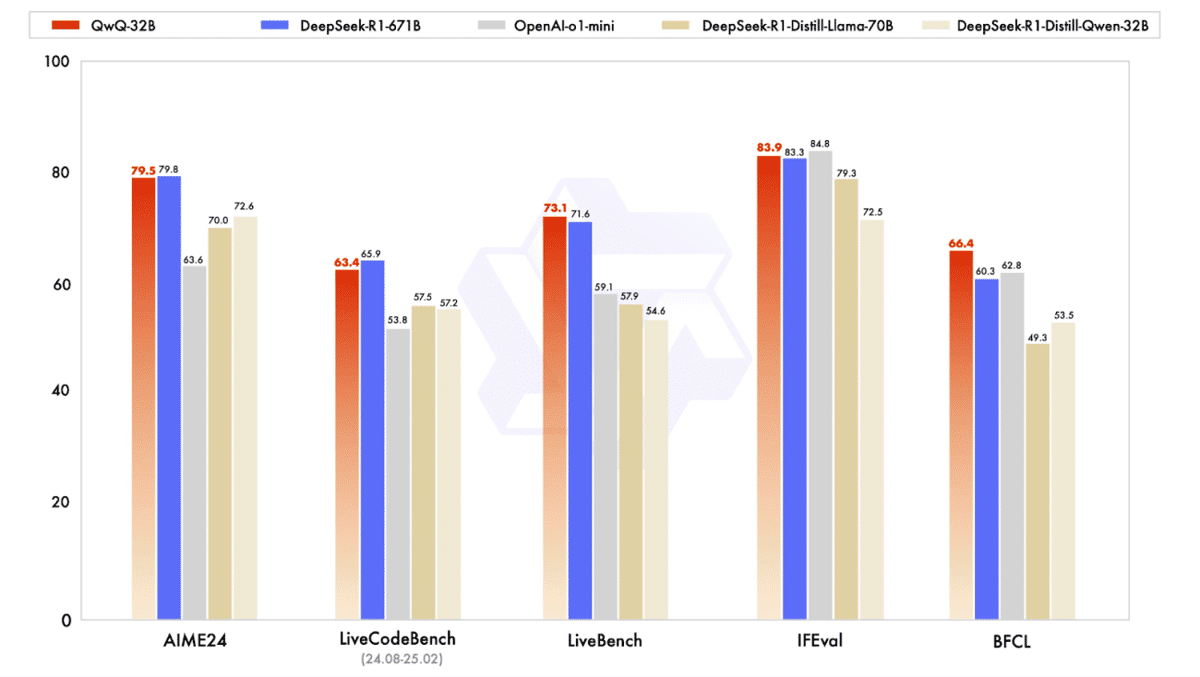
Source: Qwen
Recently, they launched QwQ-Max-Preview, built on the Qwen 2.5 Max, specialising in mathematics and coding-based tasks. On the LiveCodeBench leaderboard, a platform that evaluates LLMs for code, the QwQ-Max-Preview scored 65.6 points, higher than OpenAI’s o1 medium (63.4) and o3 Mini Low (60.9).
It was then mentioned that smaller variants of QwQ reasoning models will be open sourced for local device deployment – and the QwQ 32B model is likely the first variant.
Alibaba, too, recently released the Wan 2.1, its open-source video foundation model, which can generate videos with complex motions that accurately simulate real-world physics. The suite includes three main models: Wan2.1-I2V-14B, Wan2.1-T2V-14B, and Wan2.1-T2V-1.3B.
The I2V-14B model generates videos at 480P and 720P resolutions, producing complex visual scenes and motion patterns.
The model outperformed OpenAI’s Sora on the VBench Leaderboard.
Last week, the company announced that it plans to invest over $52 billion in the cloud computing and artificial intelligence sector over the next three years. This investment exceeds the company’s total AI and cloud spending in the past decade.
During the earnings call, Eddie Wu, CEO of Alibaba Group, said, “We see AI as a once-in-a-generation industry transformation opportunity, and the primary goal of our AI strategy is to pursue the realisation of AGI (Artificial General Intelligence) and continuously push the boundaries of model intelligence capabilities.”
Spotted an error? Tell our editors. Read our editorial standards and corrections.